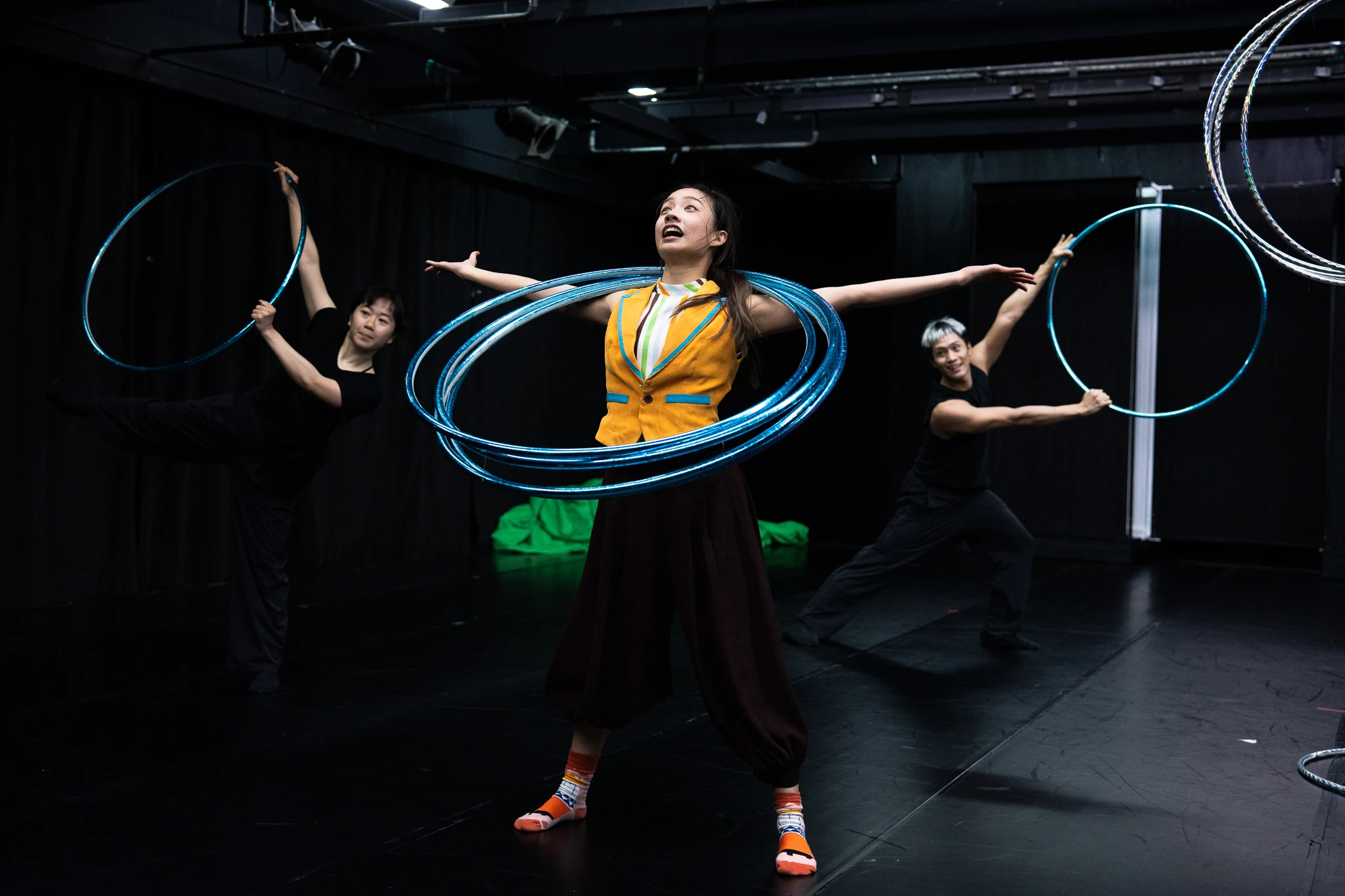
The most striking body in a dance photograph does not necessarily explain the action on its own. What the hands touch, where a prop extends, and where other people stand all affect how we read a pose. When choosing rehearsal photographs, follow those connections before deciding which frame to keep.
In Moss & Grain’s Peter and the Wolf rehearsal photographs, hoops offer a particular route through the images. Their clear shapes intersect with arms, torsos, and other performers. They shift the editing question from “Which pose looks best?” towards “Which visible relationships make this action readable?”
Look to either side before returning to the centre
The performer in the yellow waistcoat draws attention first, arms extended and several blue hoops around the body. Yet the performers on either side are more than background. Their outstretched arms, angled bodies, and held hoops carry the composition outwards.
Concentrating on the centre gives us an individual pose. Reading the sides as well shows how different bodies share the frame. That does not explain the choreographer’s intention, nor require us to assign character names. Position, direction, and the placement of the hoops provide specific things to notice.
Try a simple check when editing: after the eye leaves the central figure, what can it follow? If the other performers clarify the direction of the action, their presence matters to the selection and layout. They should not be treated merely as a backdrop.
A repeated prop can connect separate actions
Another group photograph places the performers at different depths. A figure in black holds hoops in the foreground, while the yellow waistcoat and other performers remain visible further back. Rings of different apparent sizes overlap, drawing the eye between near and far.
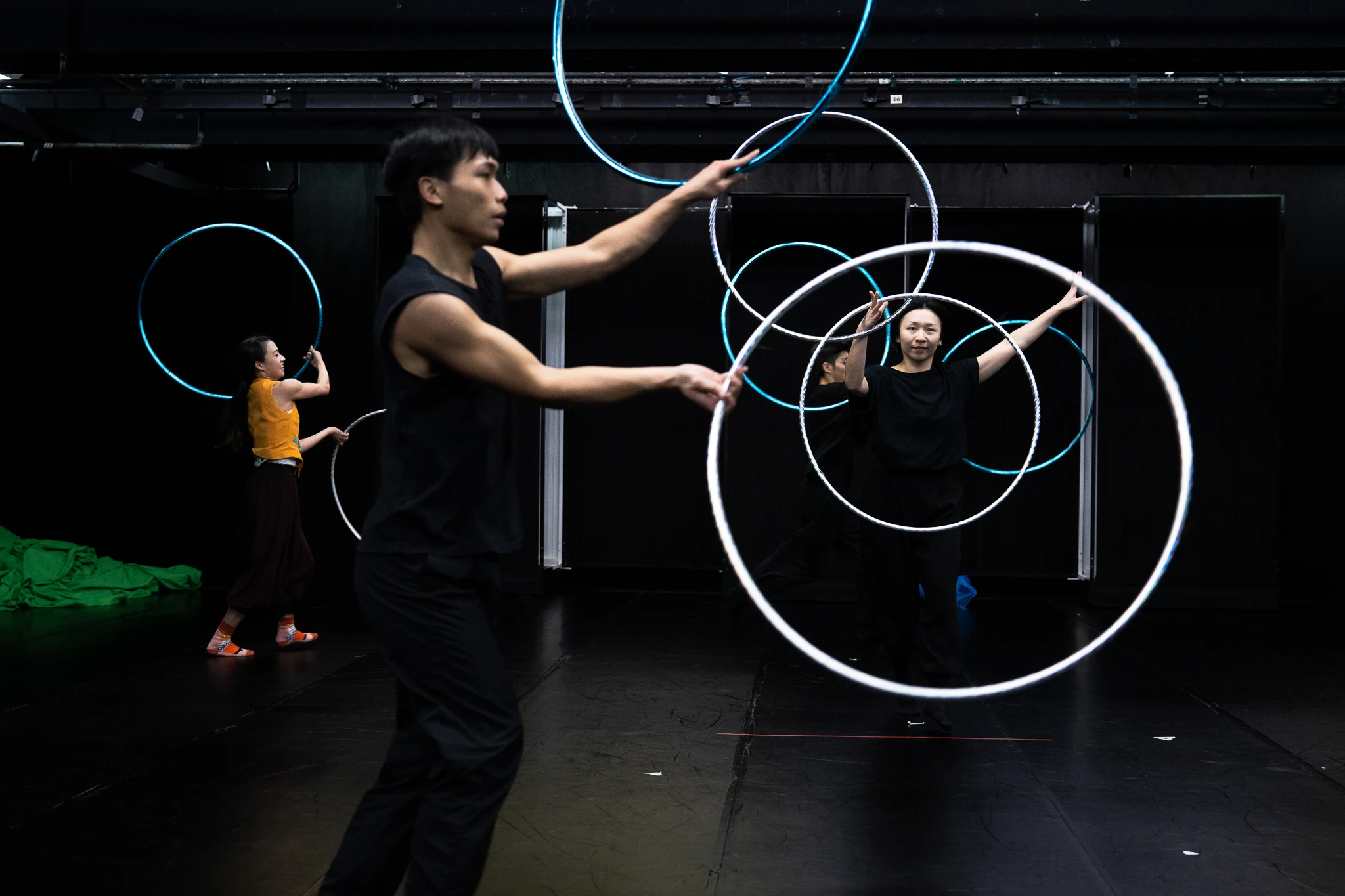
The useful information here is not a tidier formation, but the visual relationship between people occupying the room together. The foreground performer is not entirely sharp, yet the position of hands and props remains readable. Alongside sharpness, assess whether the essential connections survive. Blur alone does not give an image movement or narrative value.
Compare this photograph with the lead image. Does it change how we understand the group? The first gathers attention around the centre; the second offers several points of entry at different depths. The hoops recur, but the way we look through the photographs changes.
Move closer to the hands for a specific detail
The closer view of the white hoops brings attention to where the two hands meet the props. One hand grips a hoop higher up; the other sits near the area below the face. Curves cross around the body in different directions against the black background.
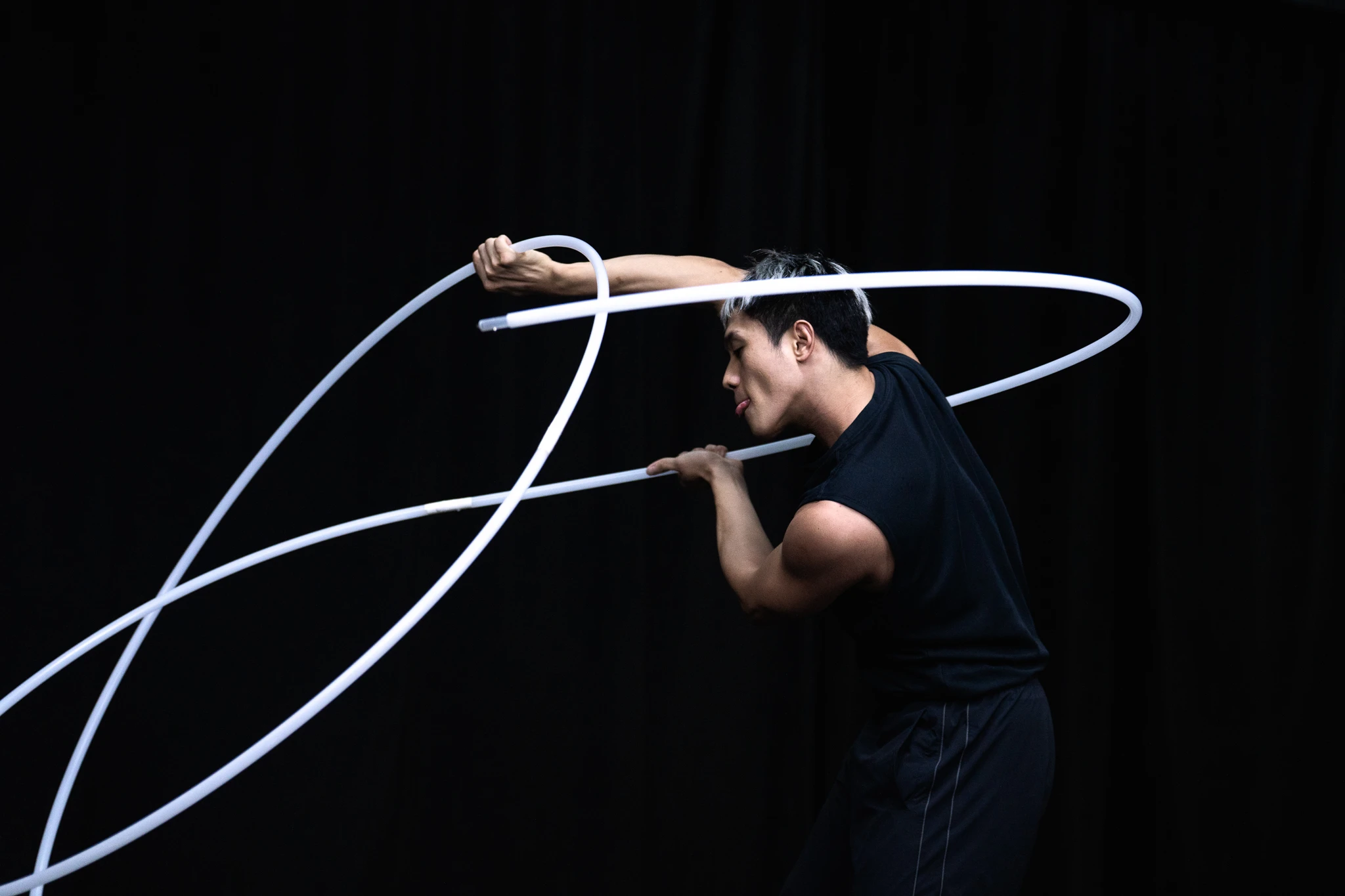
Rather than isolating an expression, this distance shows the contact between body and object. It does not establish grip strength, the name of a technique, the next movement, or whether an attempt succeeded. A useful detail photograph can stay with visible contact. It does not need claims of difficult training or perfect control to complete its story.
This gives detail selection a practical boundary: retain something that identifies an action, not simply an attractive abstract line. When readers return to the group photographs, they have another specific connection to look for.
Build a reading sequence without inventing a timeline
These three photographs can be arranged around group spacing, overlapping depths, and contact between hands and hoops. That is an editorial sequence. It is not a record of the rehearsal’s chronology, or a consecutive burst showing one movement from beginning to end. Without checked timings and session notes, words such as “next”, “finally succeeded”, or “after the correction” would invent a story between the frames.
For a first selection, choose a readable group relationship, a photograph that changes the viewing position, and a detail that makes contact clear. Describe each image’s contribution in one sentence. If all three sentences say only “powerful movement”, look again for a more precise difference. This is a starting exercise, not a compulsory format for every rehearsal.
Our Chongyang Elementary School workshop article considers shared activity and individual responses. Here, the emphasis is different: how props make separate bodies readable together. Looking beyond the most prominent performer allows rehearsal photographs to retain more of the group.