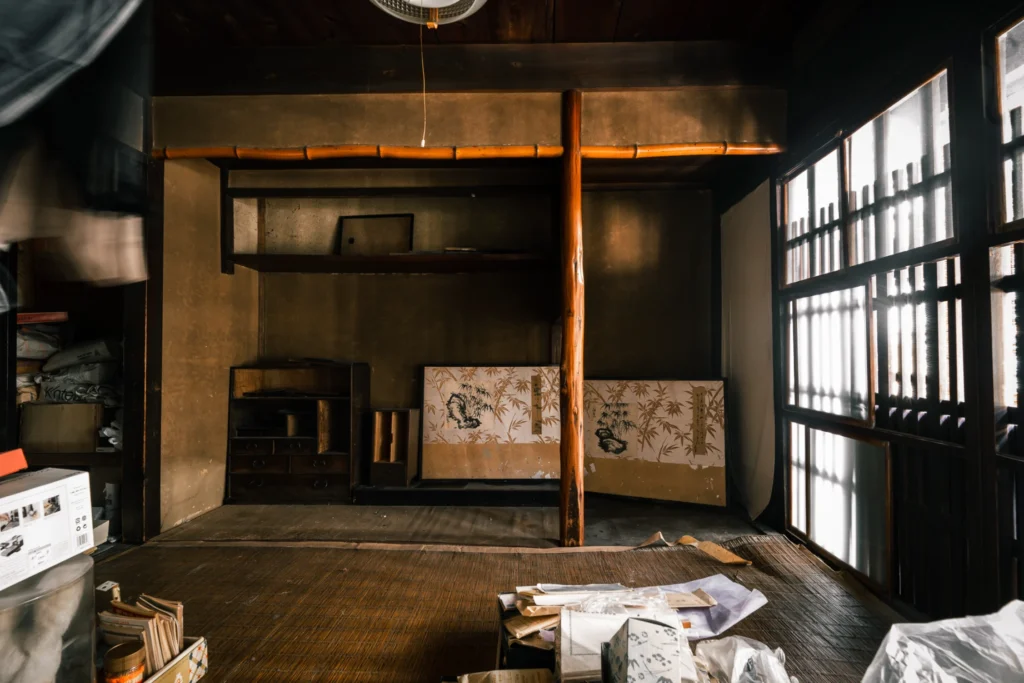
A shopping arcade may have a continuous roof without an even blanket of light. People cross a bright patch and enter shade. Shopfronts remain dark while a sign or a fabric curtain stands out. In photographs of these streets, the vanishing point is only part of the story. The boundary between light and shade deserves attention too.
These Onomichi photographs appear in Moss & Grain’s Onomichi Roman Coffee collection. Here, we stay outside the café to consider how covered passages divide the light, changing the way we read people, distance, and surfaces. This is a reading of photographs, not a walking route reconstructed from their order.
The roof runs ahead; the light crosses the street
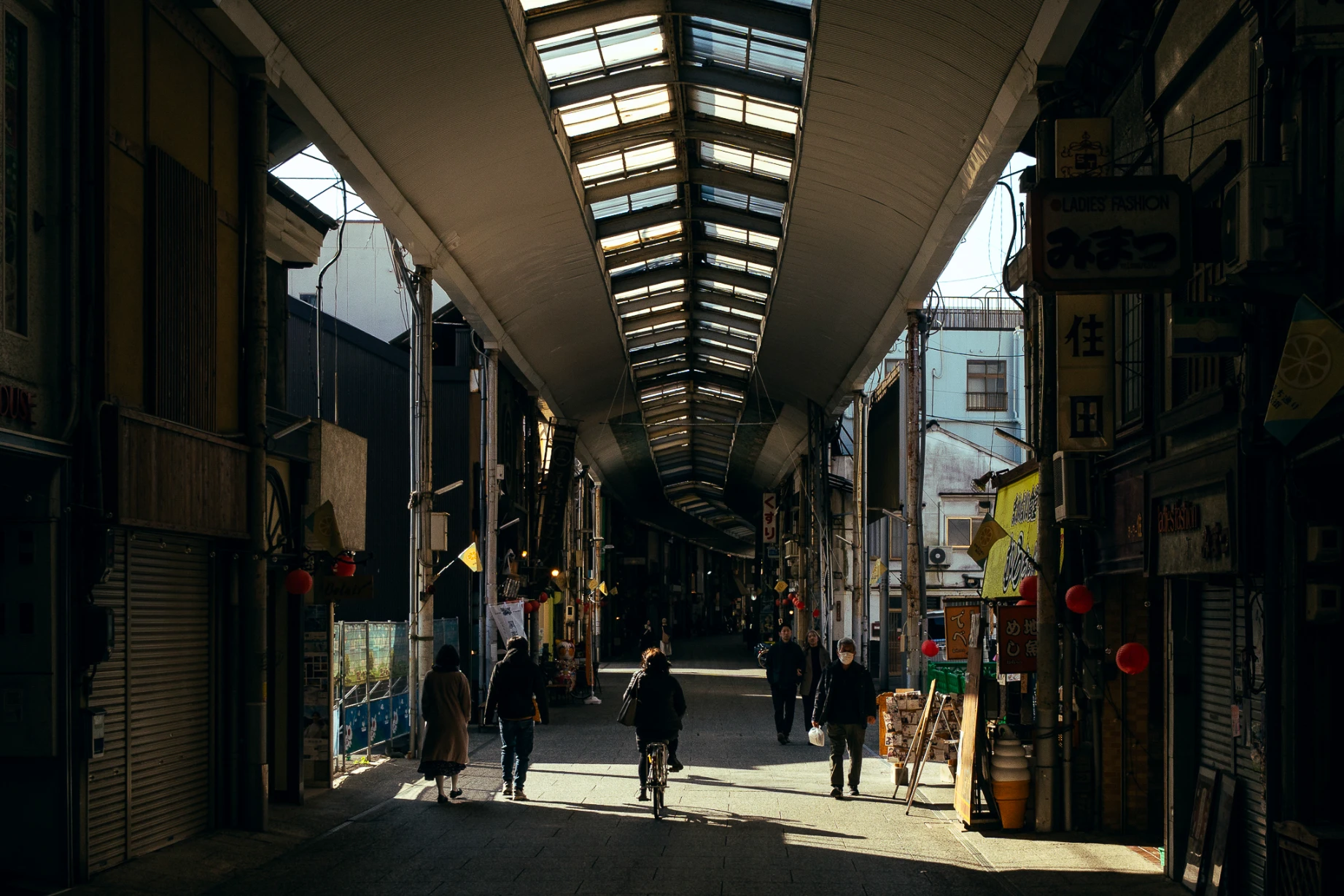
In the lead photograph, roof beams and glazed panels converge in the distance. Signs diminish along either side. These lines draw the eye forwards, while a bright band across the foreground separates pedestrians and a cyclist from the darker background.
A perfectly centred, symmetrical view might make the roof the whole subject. This photograph offers another relationship: light on the ground divides a forward-running street into near and far. People need not stand at the vanishing point to help describe its depth.
When reviewing your own images, set the lettering aside for a moment. Find the clearest light–shade boundary on the pavement. Does it follow the street or cross it? On which side are the people? Answer those questions before deciding whether a more central viewpoint would help.
A darker lane gives the distance weight
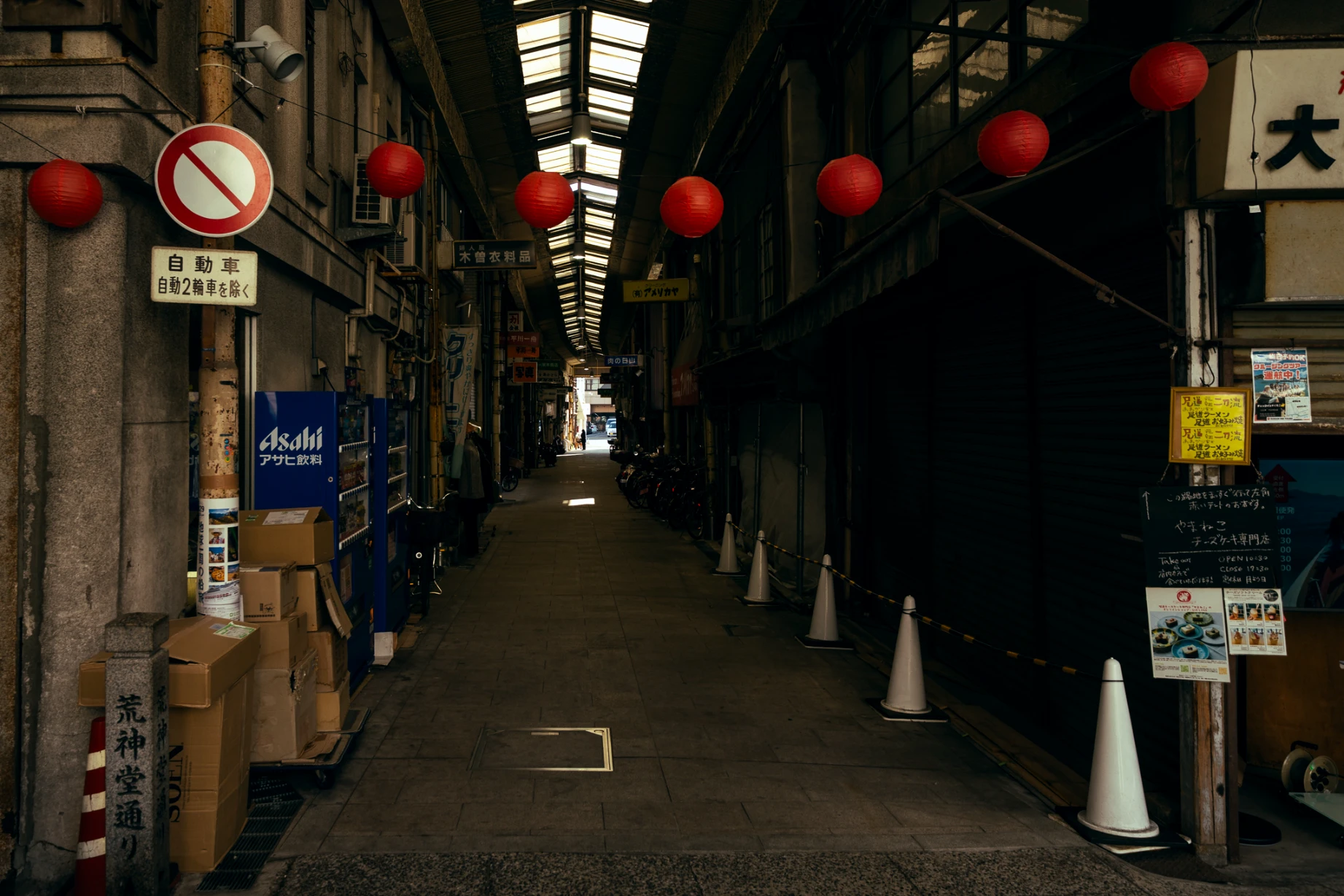
Another photograph looks into a narrower covered passage. A blue vending machine sits on the left; shutters and cones line the right. Red lanterns hang across the upper frame. The bright far opening and a small patch of light on the ground give the shaded foreground something to be measured against.
Colour plays a part as well. The roof and pavement pull the eye forwards, but the lanterns cross that direction and hold attention nearer the camera. The brightest area need not decide the entire order of viewing. Colour and transverse lines can create a pause within the shade.
There is therefore no need to make every dark area equally clear when editing. First ask whether the relationship between the vending machine, the edge of the path, and the shopfronts remains legible. If it does, retaining some darkness allows the distant opening to keep its emphasis. This is a judgement about the image, not a universal exposure setting.
Face the shopfront and light describes a surface
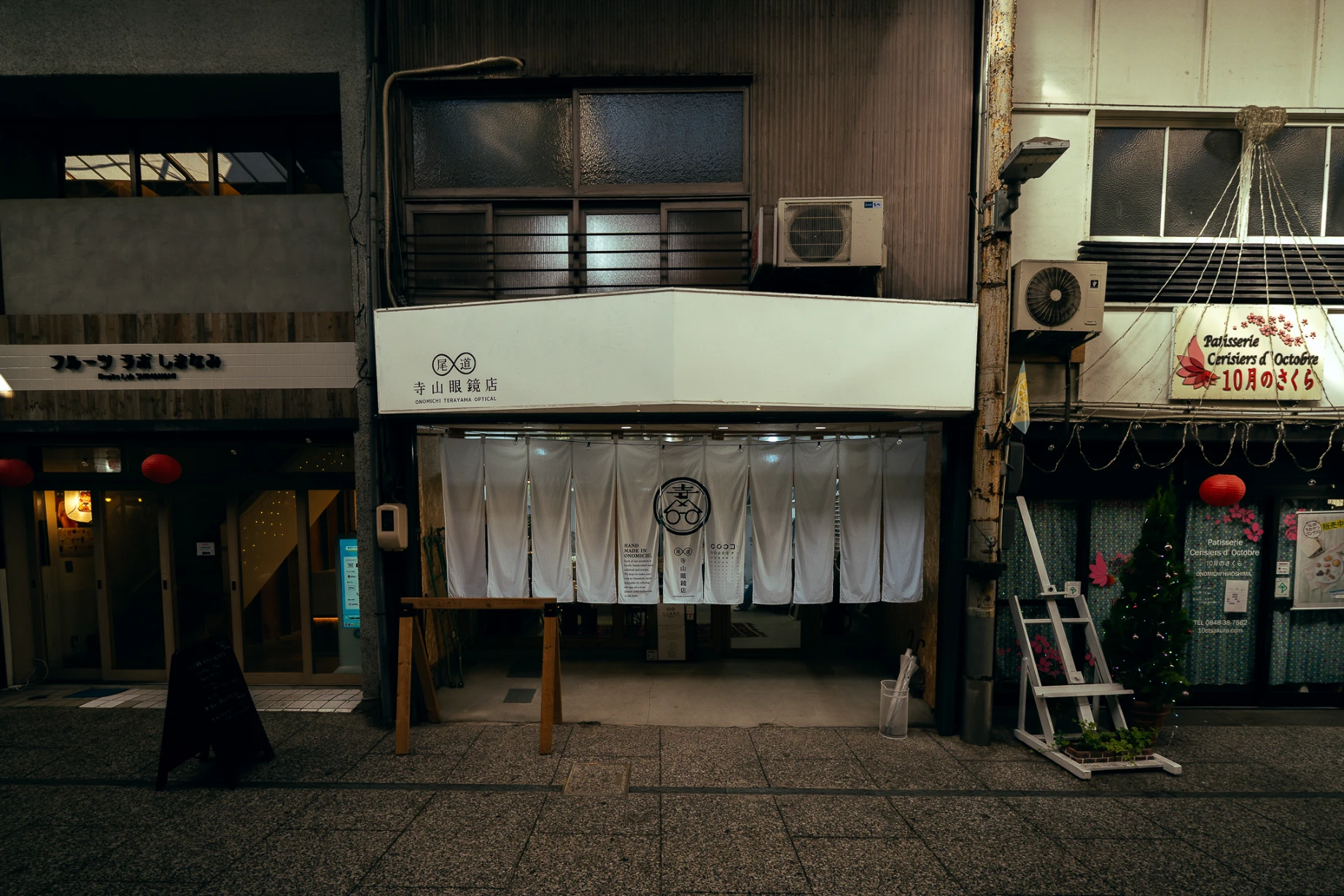
The optician’s photograph no longer uses the road as its main axis. A white sign, fabric curtains beneath it, and upper windows form distinct areas of brightness in a frontal view. Folds remain visible in the fabric. A railing, window frames, and air-conditioning units occupy darker areas.
When light stops directing us into the distance, it can still help distinguish surfaces. A white sign need not become a blank rectangle, nor fabric a glowing backdrop. Keeping those differences is more specific than giving the whole neighbourhood the same nostalgic mood.
Shutters and shopfronts without visible customers do not, by themselves, tell us that a business has closed or a street is declining. Lanterns do not establish which event was taking place. Keeping the words within the evidence prevents a ready-made story from taking over the photographs.
Begin the next photograph with a boundary of light
From a position that leaves the passage clear, look for a light–shade boundary. Try reading it in two directions: along the street, where it may separate distances, and towards a shopfront, where it may distinguish materials. There is no fixed number of pictures to collect. If turning the camera adds no useful relationship, the extra view need not stay.
Review the thumbnails together. Does every photograph offer only a bright point at the far end? Does one make movement across the pavement clearer, while another lets a surface become readable? What matters is the work the light does in each frame, not whether the photographs are equally bright.
The Onomichi Roman Coffee collection places these street views alongside café interiors. For an actual visit, use the official Onomichi Hondōri introduction (in Japanese) for area information rather than inferring opening hours or a best shooting time from the pictures. A covered street can be remembered through more than one kind of light.